Posts

Patent Office Examiners Can Use Just Unlabeled Drawings From a PriorArt Document To Reject Your Application

Image
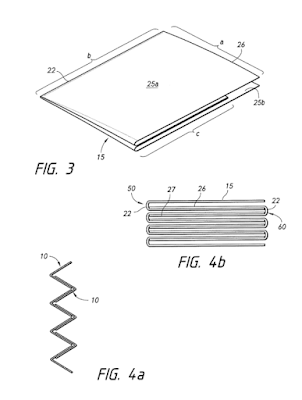
In developing a patent filing strategy, it can be prudent to utilize prior art searches to ensure that there is strategic value in the potential scope of coverage sufficient to warrant the investment in preparing and filing a new patent application. However, sometimes inventors can too easily dismiss prior art references by focusing on the details of the reference. A patent examiner can and will cite references for just a portion of what is disclosed, sometimes perhaps only using a drawing that happens to show a features that has nothing to do with the invention claimed in the patent document itself. In other words, while an inventor may dismiss the prior art document because it focuses/claims some specific features that is quite different from what the inventor considers to be their invention, patent examiners look at a reference for all that it discloses and do not dismiss a reference because of its focus/claims. In this way, as noted above, eve a patent drawing (without labels...

Portfolio Development Strategies For Industrial Firms

Image
Patents are a critical element of a company’s business strategy and can operate as insurance to protect investment in new product development. One strategy is to have engineers and scientists working in the company submit invention disclosure when they believe a new invention has been made. While this is a standard practice, it may not always drive strategic patent filings specifically tied to the business investment in new products. An additional strategy that may be used is to drive patent filings more from the business perspective that is more tied to the marketing and business strategy considering where competitive activity is expected. This approach is more appropriately terms a portfolio development approach, and can lead to higher value patents that better protect strategic business directions. As engineers and scientists tend to focus more on the scientific advancement necessary to form an invention, intellectual property specialists can assist in leading mining sessions ...

Cobots And Value Added Tasks

Image
Collaborative robots (cobots) are designed to be easy to program and re-program, easily move between one facility location and another, and have a low upfront cost.  They are designed to work with, not replace humans.  At last week’s Coffee with Cobots, commercialization and partnership expert David McFeeters-Krone, in partnership with Oregon and Washington’s Manufacturers Extension Partnership programs and Bill Smart of Oregon State discussed the application of cobots to help expand the workforce and service the unmet needs created by the expected 2 million unfilled manufacturing job vacancies expected over the next ten years.  In under a minute, it was possible to program the cobots available at the meeting to execute simple tasks.  Oregon State has a charter to help local industry and is available to partner with local industries to establish a proof of concept for the use of these robots.  Do you have dangerous, dirty, dull or hard tasks at your facility? C...

Reaching for the Summit of Autonomous Mobility Technology

Image
We recently had the opportunity to attend the Autonomous Mobility Summit, a meeting of field experts and stakeholders hosted by Technology Association of Oregon (TAO) . The conference included representation everywhere from vehicle manufacturers to public utilities to policy stakeholders. Though seemingly eclectic, this group shared the common goal of positioning Oregon to be a leader for next-generation mobility solutions. Conferences such as these are beneficial not only for uniting entities in a mission bigger than themselves but also to figure out what their niche is in the landscape as a whole. For example, from a business standpoint, technological redundancies can be avoided and companies can get a better sense of where technology is moving. Moreover, by interfacing with others in this way, companies have the ability to anticipate where they will fit into that technological landscape in the future and coordinate their IP appropriately. In this way, companies not only get ...

Scaling Your Business through Partnership

Image
I recently had the privilege of attending an educational workshop as part of the Oregon Entrepreneurs Network (OEN) Angel Food Conference and Education Series 2019 . The workshop centered on the topic of scaling up businesses in the food and beverage sector. Being a food science graduate and getting to work in food and beverage related patents, I was excited to learn about challenges for food and beverage businesses as they begin to grow. Discussion ranged from production to distribution to financing. No matter the topic, however, one of the central themes was finding partners that are the right fit for the various growth stages of your business. These partners come in many forms, such as mentors, employees, co-packers, distributors, and financial institutions. And these partners can further include intellectual property (IP) counsel. Finding IP counsel that understands your business and how to serve your business as it grows is an invaluable asset. The right IP partners can hel...

Diversity in Patent Drafting

Image
My Thanksgivings growing up were potluck-style, my family bringing traditional Persian foods, my aunt’s family bringing traditional Filipino foods, and everyone doing their best imitation on traditional Thanksgiving dishes. I’ve found that using a similar mindset can greatly improve patent drafting and prosecution. Unlike a more traditional patent law firm model where applications in a specific field are drafted by an individual who only works in that field, I’ve been exposed to different approaches with patent technology specialists having diverse backgrounds working with experienced attorneys who practice in a wide range of technologies.  Why can this be advantageous? Patent drafting inevitably requires some amount of learning. Inventions are, by definition, new and anyone other than the inventors is not an expert. Traditional firms might think it is beneficial to assign these inventions only to attorneys and/or agents considered experts in a particular field that seems ...

Inter Partes Reviews Wipe Out Three Napkin Patents

Image
Have you ever read an article about a new patent, or seen a patent number on a product, and thought to yourself, “You can patent that??”  After nearly eight years in the intellectual property field, I’ve read some patent applications that were real doozies, but rarely do the really “out-of-the-box” ideas make it all the way to being a granted patent.  Consider, for example, napkin folding.  Is napkin folding an area of intellectual property that is hotly sought after?  It turns out, yes it is, as highlighted by three inter partes reviews (IPRs) that were recently entered by the Patent Trial and Appeal Board (PTAB).  In February, the PTAB entered three IPR decisions relating to three patents owned by Essity Hygiene and Health AB and all directed to folded napkins ( 8,597,761 , 8,273,443, and 9,320,372 ).  Did you just ask yourself, “Someone got not one, not two, but three patents to folded napkins?”  Because I did.  But all  joking asi...