Posts

Showing posts with the label claims

What's In A Name

Image
What’s in a name? Juliet’s famous question about Romeo’s Montague name brings about one of the most well-known Shakespeare quotes - that a rose by any other name is still a rose. At the USPTO, examiners have a tendency to be very flexible in mapping claim elements to prior art references under the guise of the Broadest Reasonable Interpretation. For example, it would not phase most patent prosecutors if an examiner alleged that a claim to a “flower” was anticipated by a prior art reference disclosing a “thorn” under the theory that a flower, under the BRI, can refer to the whole stem and flower, and thus include thorns. Strained and even nonsensical interpretations are common, and maintained even up to appeal, as we see in a recent example regarding engine pistons (15/512,560) to Volvo Truck. Here, the invention relates to a reciprocating machine, such as a combustion engine, having groove patterns provided in cylinder walls for collecting oil. Claim 1 is below:  1. A reciproca...
Unintended Waiver

Image
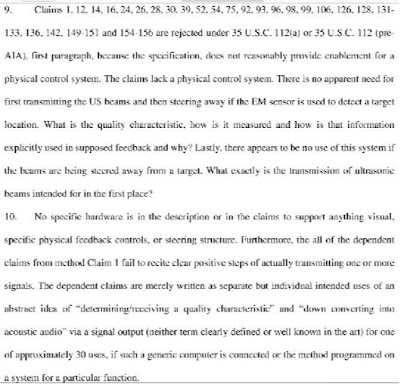
Sometimes a case has a whole slew of rejections that all relate to a common issue or complaint by an examiner. Further, the rejections can be somewhat sloppy, incomplete, and overlapping and create a bit of a jumbled mess. While it may be possible (although not recommended) to write some general remarks in response to an Office action without clearly addressing each ground and have the examiner consider it fully responsive, when the case is on appeal one must be very careful to address every ground of rejection in a separate section of the brief, and in doing so address the specific requirements of each ground of rejection.   Here we see an example where the applicant had what looked to be a winning case, but did not fully address all grounds of rejection and thus suffered the result of waiver. The case is SN 13/920,296 and relates to steering systems.  While ownership was not fully investigated, the case seems to belong in some way to Intellectual Ventures, which by all acc...

Dispensing with the Formalities: Ex Parte Quayle Actions

Image
Checking my email after work one day, I was greeted with some unfortunate news: the application I was prosecuting had received yet another Office action.   Frustrated, I couldn’t resist skimming the substance of the rejection.   After all, like any patent practitioner, I thought my arguments were pretty irrefutable.   The news only got worse… or so it appeared.   The Office action was something called an “ Ex Parte Quayle action.”   Having never received one of these actions, I started mentally preparing myself to pull out the MPEP and research some arcane rejection. To my surprise, I didn’t find myself knee-deep in case law the following day.   Ex Parte Quayle actions, while somewhat inconvenient, are far from insurmountable.   In short, an Ex Parte Quayle action or “Quayle action” is issued when an application has objections remaining as to formal matters, but is otherwise allowable.   Accordingly, the mailing of these actions close...

MAKING THE MOST OF AN IP PORTFOLIO

Image
As mentioned in our previous post, approaches for developing and managing your IP portfolio need to change to keep up with changes in technology.  Due to rapid progress in technology, a patented technology may only be commercially desirable for a limited amount of time, such as a few years.  However, patents typically have a term of twenty years.  How can you make the most of your patent during the entire duration of its term?  One approach during concept development and drafting of the patent application may be to include disclosure of how your inventive concept could be used in technologies that are only newly emerging, but may be mainstays down the road.  For example, in automobiles, it may be wise to consider how an inventive concept could be used in a hybrid or all electric vehicle, or how the inventive concept could be used in an autonomously-driven vehicle.  You could include claims directed to the use of the inventive concept in these newly-emergi...