Posts

Unintended Waiver

Image
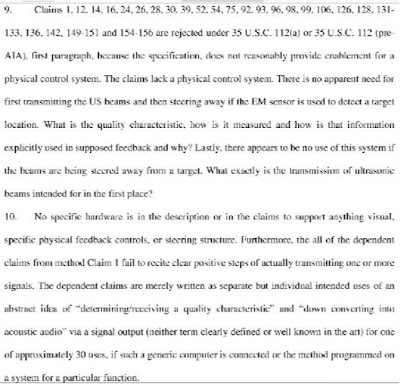
Sometimes a case has a whole slew of rejections that all relate to a common issue or complaint by an examiner. Further, the rejections can be somewhat sloppy, incomplete, and overlapping and create a bit of a jumbled mess. While it may be possible (although not recommended) to write some general remarks in response to an Office action without clearly addressing each ground and have the examiner consider it fully responsive, when the case is on appeal one must be very careful to address every ground of rejection in a separate section of the brief, and in doing so address the specific requirements of each ground of rejection.   Here we see an example where the applicant had what looked to be a winning case, but did not fully address all grounds of rejection and thus suffered the result of waiver. The case is SN 13/920,296 and relates to steering systems.  While ownership was not fully investigated, the case seems to belong in some way to Intellectual Ventures, which by all acc...

Dispensing with the Formalities: Ex Parte Quayle Actions

Image
Checking my email after work one day, I was greeted with some unfortunate news: the application I was prosecuting had received yet another Office action.   Frustrated, I couldn’t resist skimming the substance of the rejection.   After all, like any patent practitioner, I thought my arguments were pretty irrefutable.   The news only got worse… or so it appeared.   The Office action was something called an “ Ex Parte Quayle action.”   Having never received one of these actions, I started mentally preparing myself to pull out the MPEP and research some arcane rejection. To my surprise, I didn’t find myself knee-deep in case law the following day.   Ex Parte Quayle actions, while somewhat inconvenient, are far from insurmountable.   In short, an Ex Parte Quayle action or “Quayle action” is issued when an application has objections remaining as to formal matters, but is otherwise allowable.   Accordingly, the mailing of these actions close...

Star Wars and IP Strategy

Image
“In my experience, there’s no such thing as luck” ( Obi-Wan Kenobi, Star Wars Episode IV: A New Hope), but there is such thing as a strong intellectual property strategy. The Star Wars franchise is a prime example of what a strong intellectual property strategy can do for a brand. They have developed a diverse portfolio over the years, leveraging their trademarks, patents, and copyrights for additional revenue in licensing. While the Star Wars franchise is recognized for their unique novel designs, catch-phrases, or iconic branding – the creativity and innovation to bring the story to life has created novel methods for production as well. The Star Wars saga is filled with futuristic technology whose written mechanical systems are inspired by mechanical engineering, physics, and space to name a few. It is one of those brands that pushes innovation in technology forward. The brands current owners, Disney Enterprises, has taken the concept of light sabers and brought them to ...

Strings Attached to Restriction Requirements

Image
If you prosecute patent applications long enough, you are bound to receive a restriction requirement. Restriction requirements have become quite common, with the overall restriction rate estimated to be a little more than 50%. Restriction requirements can create headaches for applicants by limiting the ability to amend claims during prosecution. Applicants should also beware that other strings are attached to restriction requirements. For example, in the case of a species restriction: “If claims are added after the election, applicant must indicate which of these claims are readable on the elected species or grouping of patentably indistinct species.” (MPEP 809.02(a)) That is, for the remainder of prosecution after a species has been elected, any added claims need an extra statement to indicate their species. An extra statement may seem small in the scheme of everything, but forgetting this little indication could give the Examiner an avenue to stall the application.   ...

The Wowshi - a story of a father-son inventor team that fought for 10years to obtain a patent on their new pita process

Image
Food processing technology is an active area for patent filings. Even the fundamental concepts of a new restaurant can be the subject of patent protection. Today we tell the story of one such patent as gleaned from publicly available documents and other on-line resources. The story of US Patent 10,528,915 (Sanadidi, et al.) issued January 7, 2020 is that of a father and son inventor team who start their own restaurant ( Bella Pita ) in the LA area (there are two locations). M. Y. Sanadidi and his son Ezedin co-invented the idea for the new Mediterranean-style restaurant, which they opened in 2007. As M. Y. explained, they wanted to do something different: “… we [] resolved to determine whether there was any innovation that we could bring to the field of Mediterranean-style restaurants that would make us stand out from the many other restaurants of this type.” It turns out M.Y. was a professor of computer science at UCLA and an inventor on several patents related to com...

Patent Office Examiners Can Use Just Unlabeled Drawings From a PriorArt Document To Reject Your Application

Image
In developing a patent filing strategy, it can be prudent to utilize prior art searches to ensure that there is strategic value in the potential scope of coverage sufficient to warrant the investment in preparing and filing a new patent application. However, sometimes inventors can too easily dismiss prior art references by focusing on the details of the reference. A patent examiner can and will cite references for just a portion of what is disclosed, sometimes perhaps only using a drawing that happens to show a features that has nothing to do with the invention claimed in the patent document itself. In other words, while an inventor may dismiss the prior art document because it focuses/claims some specific features that is quite different from what the inventor considers to be their invention, patent examiners look at a reference for all that it discloses and do not dismiss a reference because of its focus/claims. In this way, as noted above, eve a patent drawing (without labels...

Portfolio Development Strategies For Industrial Firms

Image
Patents are a critical element of a company’s business strategy and can operate as insurance to protect investment in new product development. One strategy is to have engineers and scientists working in the company submit invention disclosure when they believe a new invention has been made. While this is a standard practice, it may not always drive strategic patent filings specifically tied to the business investment in new products. An additional strategy that may be used is to drive patent filings more from the business perspective that is more tied to the marketing and business strategy considering where competitive activity is expected. This approach is more appropriately terms a portfolio development approach, and can lead to higher value patents that better protect strategic business directions. As engineers and scientists tend to focus more on the scientific advancement necessary to form an invention, intellectual property specialists can assist in leading mining sessions ...