Posts

Surprising Uses for Oobleck

Image
Oobleck is a common name for a non-Newtonian fluid comprising cornstarch and water. Named after a substance humorously described in Dr. Seuss’s classic children’s story, Bartholomew and the Ooblek, the cornstarch and water concoction is frequently used in children’s science classes as a fun way to learn about fluid mechanics. You may have fond memories, yourself, of playing with oobleck as a youth. Oobleck behaves as a fluid when touched gently, but becomes hard as a solid when hit with great velocity. For example, a person could run across a swimming pool of oobleck without getting their feet wet. However, if a person stood still on the oobleck, then they would slowly sink. Because oobleck is a children’s plaything and because of its simple recipe (cornstarch and water), one may be surprised to learn that inventors have attempted to patent serious industrial uses for the material. As an example, one current patent application, US 2015/0016885 (now abandoned), is for a system of fi...


The Integrated Fan-Out Package and the Patents Protecting It

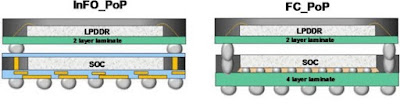
Manufacturing processors for Apple’s iPhone is prized business. The development of the Integrated Fan-Out (InFO) package has helped Taiwan Semiconductor Manufacturing Company (TSMC) manufacture the Apple A10 and A11 processors. Competitors such as Samsung have manufactured processors for Apple as recently as the generation before the introduction of InFO. The InFO package is not a radically new design. InFO is a combination of processes that are known in the field. Fan-out wafer level processing (FOWLP), which InFO is based on, has been in use since embedded wafer-level ball-grid arrays in 2009. However, the InFO packaging combine FOWLP with redistribution layers, through layer vias, and package on package architecture to create a more efficient overall design. FOWLP provides several advantages over other types of packaging. A fundamental problem of semiconductor manufacturing is that performance of integrated circuits increase as dimensions decrease but performance of interconnects ...

More Than Just Money

Image
Cryptocurrencies have found themselves in the spotlight as of late, with the most popular being Bitcoin.  The understanding of cryptocurrencies appears to be fairly limited, with consumers trying to predict if cryptocurrencies are a flash in the pan or here to stay.  Regardless of your assumptions regarding Bitcoin, which is often characterized as a way for drug dealers to operate without getting caught, there are over 1,000 cryptocurrencies, many of which provide a service, often regarded to as a blockchain technology.             Bitcoins blockchain technology tracks ownership of bitcoins between peer-to-peer transactions.  However, blockchain technologies offer so much more than that.  For example, Ethereum allows participants to create smart contracts, wherein the smart contract self-executes management, payment, and enforcement.  Additionally, due to the distribution of such contracts (e.g., they are...

Blockchain Technology Patents – A Flurry of Activity

Image
Blockchain patent activity is increasing rapidly. A description of the technology was first published in 2008 anonymously, and no intellectual property protections were placed on it. As the technology has become widely known due to its use by digital currencies, various established companies, as well as numerous start-ups and entrepreneurs, have begun seeking patent protection on innovations to the technology.  To date, there are over 200 US patents related to blockchain technologies granted since the beginning of 2013, including one for a digital currency ATM ( US Patent No. 9,135,787 ), one for making a payment with a tip button ( US Patent No. 9,436,935 ), and one for a system and method of analyzing blockchain transactions ( US Patent No. 9,298,806 ). There are currently over 1000 US patent applications awaiting examination. The blockchain protocol was developed to solve the technological problem of how to create an open, distributed ledger that was verifiable and immutable....

Potential Market Disruption by the Rising Role of Electronics Packaging

Image
The most cost-effective way to improve computer performance for the last several decades has been to shrink the size of the transistor.  Thousands of patent applications over the years have focused on exactly this approach.  However, shrinking the node size is becoming increasingly less cost effective. This trend is creating more incentive for the creation of other methods to improve computer performance. For example, Taiwan Semiconducting Manufacturing Company (TSMC) has created a package on package method of packaging chips that shows performance increases comparable to an iteration of node shrinkage. Specifically, TSMC has claimed that their Integrated Fan-Out (InFO) process can realize greater than a 20% reduction in overall package thickness, a 20% speed gain, and 10% better power dissipation [1] . These benefits were recognized by Apple when InFO packaging was used in their A10 and A11 processors. TSMC increased their patent filings to 873 in 2016, which is a 74% increas...

COMMENT ON CLAIM LANGUAGE

Image
It’s not something typically on the forefront of the minds of most people, but it surely strikes fear in anyone seriously contemplating it: the idea of being lost in space.  Poor George Clooney in the movie Gravity, just floating away into the abyss, without any means to return to safety!  If he only had some way…some “return home button” of sorts…. Astronauts and the public alike can rest easy, as engineers have recently filed a patent US 20170192425 A1 for a spacesuit self-return system to ensure spacewalking astronauts are safe, even in the event that none of their crewmates can rescue them. Upon seeing this news, my first thought was that such a suit would of course need sensors, a navigation system of some sort, some *safe* means of propelling the person through space, etc.  With the recent advancements in autonomous vehicle technology, I was especially curious as to how such a spacesuit self-return system might be claimed in a patent filing, to differentiate it...

The Producer

Image
The job of a patent is to protect an invention and create business value.  The job of a patent professional is to help draft the patent application to maximize this value. They can do this by making sure the invention is explained as clearly as possible through words and figures.  They can also do this by reasonably broadening the invention (for example, if the invention pertains to a glass, can it also pertain to a mug? a jug? any other liquid container?). Another way patent professional can add value is by using their creativity to help the inventor springboard their idea to new levels, similar to how a music producer helps a musician take their songs to new heights. Often, inventors (engineers, designers, etc.) suffer from tunnel vision: they becomes focused on a single aspect of their invention. This may serve them well when they are focused on a specific product geared towards a specific function with a specific deadline. That’s where a patent professional can help the...