Posts

Large-scale scientific experiments and the need for more exemptionslike the Hatch-Waxman exception in Patent Law
Image
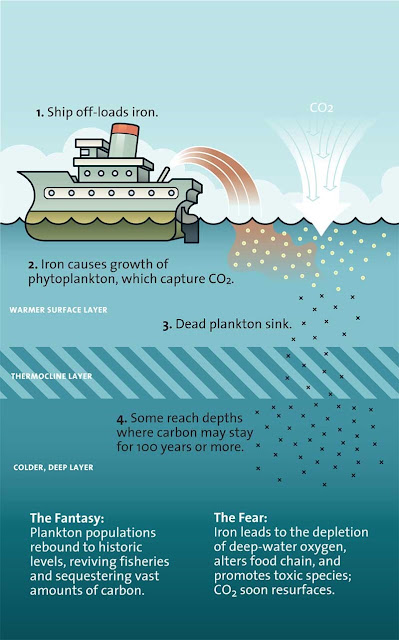
Oceanography is a fascinating field of study, encompassing knowledge from a variety of scientific and engineering disciplines.  Notable pioneering efforts in oceanography have been recognized from countries across the globe although tribute must be given to the great Jacques Cousteau for the popularization of oceanography in the eyes of the general public.  His books, films, and conservation efforts have revealed the wonders of the oceans for countless children and adults alike. In the 1980s, John Martin’s seminal work out of Woods Hole Oceanographic Institute fueled the idea of seeding algal blooms with iron, aka iron fertilization, into becoming a feasible solution to the issue of rising atmospheric carbon dioxide (CO2) levels.  The results of his studies on mapping the oceanic distribution of nutrients essential for algal proliferation confirmed the presence of large regions that are low in iron levels with respect to macronutrients such as nitrate, phosphate, and sil...

Functional Language in Claims of a Chinese Patent Application

Image
One way to draft claims for a method or a device is to describe the method or device by its function, in the form of means (or steps)-plus-function language.  However, one may want to avoid such an approach in US applications because once a claim is determined to include the means or step for language, the claim coverage is confined to the specific embodiments and examples disclosed in the specification, and equivalents thereof.  As such, claims drafted with purely functional language may have a more limited scope.  Further, the claim may have a higher likelihood to be considered invalid if the structural disclosure in the specification is not adequate. Specific terms in the claim language may indicate that the claim has a high likelihood to be considered having means-plus-function language.  For example, the U.S. patent office lists terms including “means”, “step”, “for”, “configured to”, and “so that”.  See MPEP 2181. In China, patent claims drafted in the...

Strategies for Patenting Solutions to Scaling Challenges

Image
            Whether your business has large- or small-scale production challenges, it is important to consider your intellectual property portfolio when developing solutions. There are a couple of strategies that may be helpful to improve the chances of success for applications geared towards production challenges.             One strategy for a patent application that is directed towards a solution for a large or small production scale related problem is to describe how the solution in the application may address issues associated with that particular production scale.             Another strategy may be to describe how a particular production scale enables the solution to work so that the production scale is intertwined with the solution in the application. An example of an application that intertwines the scale of the p...

Tricky Linguistics: Patent Claims

Image
You keep using that word, does it mean what you think it means? Words in patent claims are given their plain and ordinary meaning, except when they are not.  Patent claim terms are interpreted in view of the specification (written description of the invention), as would have been understood by one of skill in the art, and based on any definitions of the words in the specification.  At least, that is how they are supposed to be interpreted during prosecution before the U.S. Patent and Trademark Office.  In litigation, words in patent claims are interpreted based on all of the above and any arguments made during prosecution before the U.S. Patent and Trademark Office, testimony, expert opinions, and other unwritten sources.  While testimony and expert opinions cannot contradict the evidence put forward during prosecution, the combination of all of these sources still leaves a lot of room for interpretation. How many words to you know that have only one meaning? ...

Food and Beverage Industry Spotlight: Utility Patents

Image
As discussed in the design patent section of our food and beverage industry spotlight, patent protection can be a huge advantage for food and beverage businesses. Our earlier example illustrated design patent protection giving a food and beverage company a competitive advantage to distinguish themselves from competitors.             However, another type of patent, called a utility patent, may also be an avenue to consider when building an intellectual property portfolio for your business. Whereas design patents protect the appearance of an article, utility patents protect how that article is used or works. Utility patent protection may be available for useful, novel, and non-obvious inventions.             To give an example, a food and beverage company may patent the appearance of a bottle via a design patent. However, should that same bottle have also been developed with us...

5 Lessons from a Disney Case to Avoid Issues Caused by the PatentOffice’s Unusual Method of Interpreting Patents

Image
Patent claims are reviewed in light of a broadest reasonable interpretation (BRI) of the claim language. Specifically, following the guidance for the BRI in the MPEP (the guidelines that govern examination procedure at the Patent Office), claim language is interpreted to have its customary meaning unless the term has been defined otherwise in the specification. The claim language must also be consistent with the drawings of the specification. Seems pretty straightforward, right? Well, in practice the BRI can actually get pretty tricky, sometimes dictating the entire outcome of a case. A recent example illustrating the power of the BRI to impact the decision of a case is found at 13/223,062, entitled “INFANT BODYSUIT” owned by Disney Enterprises, Inc. Disney appealed the Rejection of the patent by arguing that the Patent Office was being unreasonable in its interpretation.  Disney lost, however, since the BRI gives the benefit of the doubt to the Examiner in most cases.  Wh...

An Industrious Solution To An Industrial Problem

Image
The term “heavy industry” conjures images such as construction equipment and materials for building various structures such as bridges, hotels, skyscrapers, etc.  Thus, of course one aspect of intellectual property related to heavy industry encompasses the development of, and improvements upon, various types of equipment related to the construction of such structures.  However, another aspect to the heavy industry market includes upkeep of such structures, once they are constructed. Toward that end, there is currently an upswing in activity in terms of obtaining patent protection for “smart” buildings, homes, bridges, etc., which may rely on network-connected sensors capable of providing real-time data pertaining to various aspects of maintenance of large structures.  However, such solutions are inherently complex, have issues related to divided infringement, and the IP space for such solutions is growing increasingly crowded.        ...